Fort Advanced Materials focuses on developing precision rework specialty chemicals and failure analysis materials for semiconductor, advanced optoelectronics, and CPO packaging.
Leading the green circulation, developing safe, eco-friendly, high-precision specialty chemicals that are fluorine/chlorine-free and non-damaging to optical substrates.
Non-toxic, halogen-free formulas friendly to the environment and human health.
Deep R&D capabilities in polymer synthesis and organic interfacial chemistry
Development of non-toxic, halogen-free, and environmentally friendly specialty chemicals
Providing zero-damage rework for advanced packaging chips and optoelectronic components
Fort Advanced Materials was founded on the pursuit of polymer materials chemistry research and quality control. We resolve the pain points of high-precision packaging rework using green chemistry, helping clients recycle high-value dies and obtain precise process inspection data.
Custom formulation of non-destructive debonding solutions according to process temperature, application time, and bonding materials, without damaging substrates.
Developing "safe non-destructive debonding solvents" essential for reworking optical and electronic components, balancing precision and green circulation.
Fort Advanced Materials integrates interfacial molecular chemistry, precision temperature-controlled optics, and semiconductor failure analysis to provide three core solutions.
Targeting Norland NOA, LOCTITE, Dexerials, and other high-strength crosslinked cured adhesives, we develop gentle-penetration and high-swelling debonding formulas to support non-destructive disassembly and recovery of precision optoelectronic components.
Specifically developed high-contrast dyeing auxiliary materials for transparent cured adhesive layers. Combined with microscopic and interferometric optical measurements, they clearly highlight adhesive layer thickness and uniformity distribution, providing precise data for failure analysis (FA).
Combining focused infrared light sources and closed-loop precision temperature control modules, working in synergy with Fort's debonding materials, it achieves high-precision non-destructive debonding while completely protecting surrounding sensitive silicon photonic active dies and micro-lenses from thermal damage.
Explaining the advanced rework chemistry principles and new molecular mechanisms behind polymer specialty chemicals in simple terms.
Cured high-strength UV adhesives or epoxy resins are difficult to remove due to 3D cross-linked networks. Fort's safe debonding solvents swell and penetrate, gently peeling them off without damaging PC and lenses.
Cured transparent UV glue has low reflectivity and strong light absorption, making conventional optical measurement difficult. Learn how Fort's patented dyes utilize interfacial capillary adsorption to develop high-contrast color, providing micron-scale interference and failure analysis data without destructive disassembly.
In advanced packaging such as CPO manufacturing, adjacent micro-lenses and active circuits are highly sensitive to temperature rise. This article reveals how our patented optical design focuses infrared energy on micron-scale gaps, activating the debonding solvent without conducting heat.
Through actual test videos and operation demos, intuitively understand the actual performance of Fort's non-destructive debonding materials and patented debonding equipment.
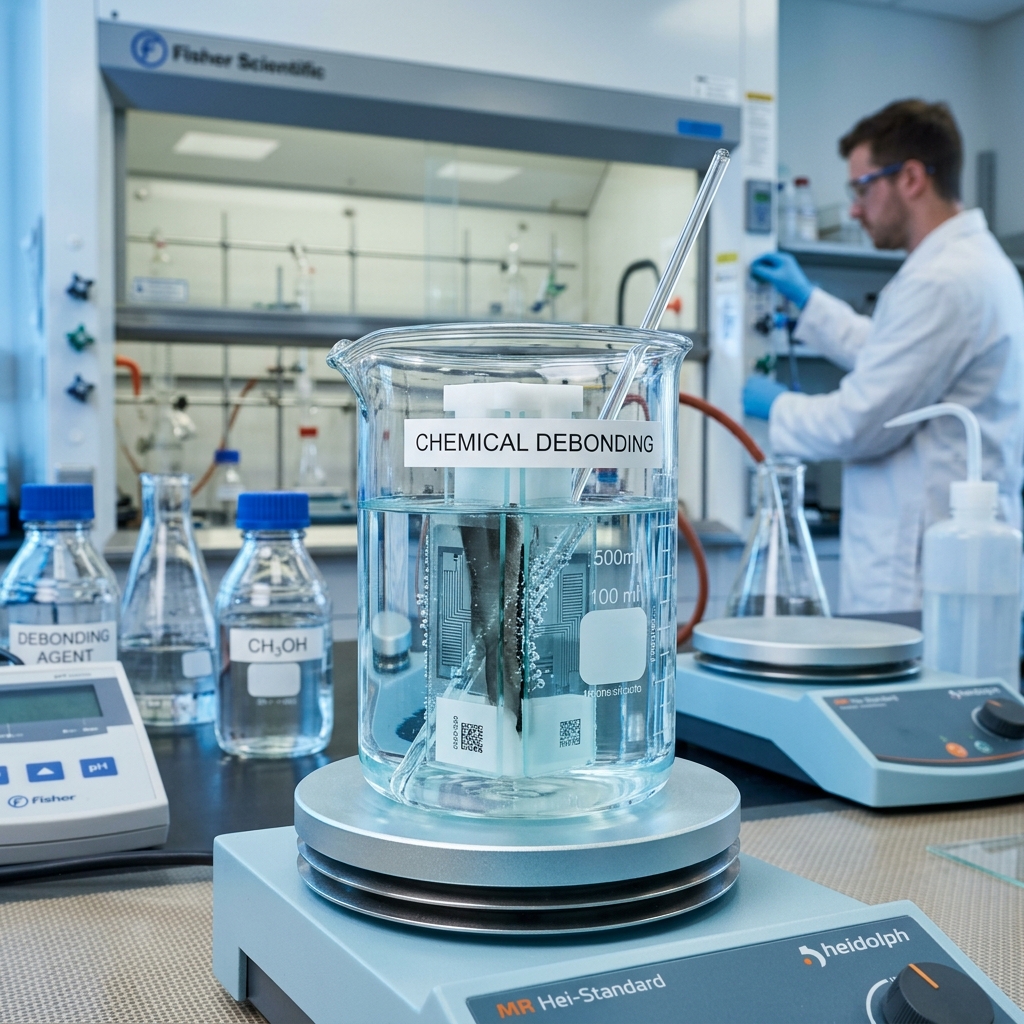
Timelapse photography showing L0-Gen-1 to L0-Gen-4 penetrating the crosslinked network to swell and release high-viscosity adhesives.
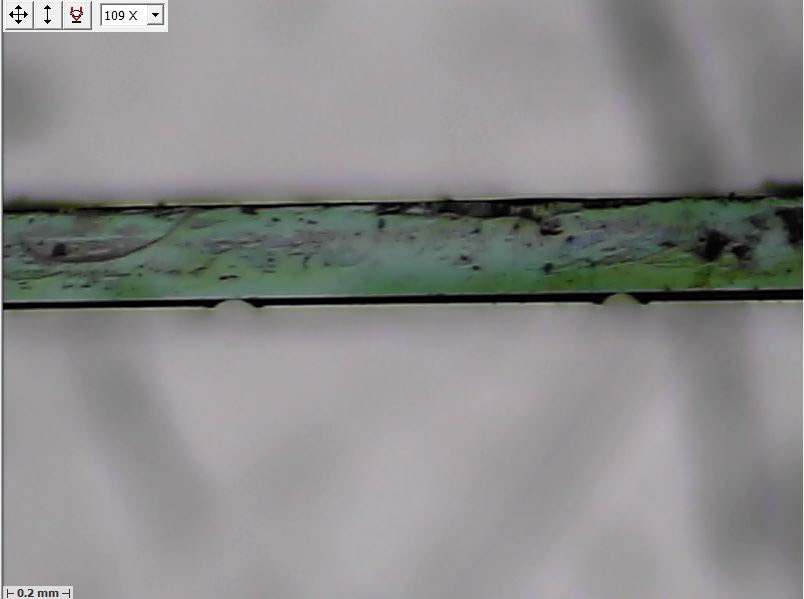
Demonstrating how focused infrared beams activate the solvent to cleanly separate components in 30 seconds without affecting surrounding micro-lenses.
Fort Advanced Materials provides high-purity specialty debonding solvents and custom formulation services. Welcome to contact our R&D team for inquiries.